 By Nicolas Maltais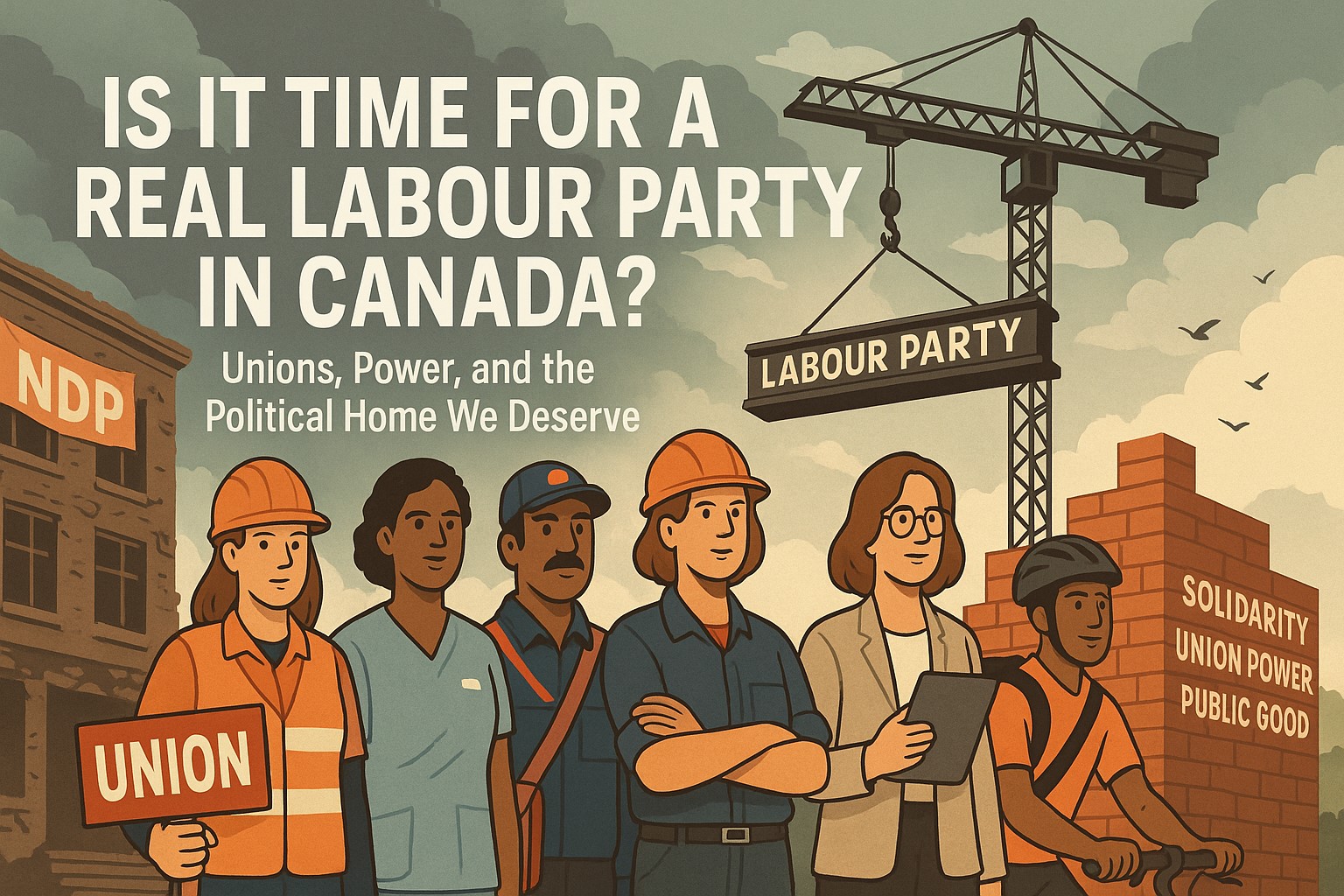
In kitchens, union halls, and picket lines across Canada, a familiar question continues to simmer: Who truly represents workers in Parliament anymore? The New Democratic Party (NDP), long considered labour’s political arm, has seen its commitment to working-class struggles questioned more frequently in recent years. As frustrations mount, some activists and union members are now daring to ask: Is it time to build a real Labour Party in Canada?
This isn’t a new idea. But with the current political landscape shifting rightward and the NDP seemingly stuck in a cycle of electoral caution, the time may be ripe to revisit it. What would it take? What lessons can be drawn from other countries? And how could such a party succeed without splitting the progressive vote?
Let’s dive in.
The Labour Party Model: Inspiration from Abroad
The clearest example of a labour-based political party is the UK’s Labour Party. Founded in 1900 by trade unions and socialist groups, the party was born out of a need for political representation of working people in the British Parliament. For most of its history, the UK Labour Party maintained a formal affiliation with major unions, who provided both financial support and political influence. While the party has at times moved toward the centre—particularly under Tony Blair’s “New Labour” era—it has always retained a foundational connection to trade unions.
Australia offers another model. The Australian Labor Party (ALP), created in the 1890s, is also deeply rooted in the union movement. The ALP has frequently formed government and continues to maintain strong formal ties with unions at both the national and state levels.
Closer to home, labour parties have existed at provincial levels. The Manitoba Co-operative Commonwealth Federation (CCF), for example, eventually merged into the NDP, as did its counterparts across the country. But none have existed nationally outside the NDP’s umbrella since that merger in 1961.
So what’s different now?
Labour’s Growing Political Void in Canada
Canadian unions have traditionally relied on the NDP to carry labour’s banner in Ottawa. In return, unions endorsed NDP candidates, contributed financially, and mobilized members during campaigns. But cracks in that relationship have widened.
Take the NDP’s performance under Jagmeet Singh: a charismatic and principled leader, yes—but one who has increasingly prioritized parliamentary stability and cautious centrism over movement-building. Despite strong union support, the party has been slow to champion bold reforms like anti-scab legislation, nationalizing key industries, or standing unequivocally with striking workers.
Many labour activists feel that while the Liberals co-opt labour rhetoric and the Conservatives attack unions outright, the NDP often plays it safe—offering soft critiques and incremental solutions. The result? A growing sense of abandonment among rank-and-file workers.
And with the rise of figures like Pierre Poilievre—who claims to stand for “the working class” while pushing anti-union policies—the need for a political home that actually represents workers has never been clearer.
What Would It Take to Build a Canadian Labour Party?
The creation of a new national labour party would not be simple, but it is far from impossible. Key steps would include:
1. Foundational Support from Unions
Any viable labour party must begin with strong backing from Canada’s largest unions. That includes not just rhetorical support, but formal affiliation, financial investment, and boots-on-the-ground organizing. Public sector unions like PSAC, CUPE, and Unifor—along with private sector giants like UFCW and USW—would need to come together around a shared vision.
This alone would be transformative. Imagine if union dues weren’t just funding grievances and bargaining, but also electing members of Parliament committed to labour’s priorities.
2. Clear and Bold Policy Commitments
A real labour party wouldn’t shy away from bold demands. It would champion:
- Strengthening the Rand Formula and expanding union rights
- Raising the minimum wage to a living wage nationally
- Banning scab labour and repealing back-to-work legislation
- Reinvesting in public services, housing, health care, and transit
- Green jobs through publicly owned energy transitions
- Protecting gig workers with full employment rights
Crucially, the platform must be developed with workers—not handed down by political strategists.
3. Avoiding the Vote Split Trap
One of the loudest arguments against creating a new labour party is the fear of vote splitting. Critics say it would divide the left, allowing Conservatives to win.
But history offers alternatives. In the UK, Labour replaced the Liberal Party over time as the primary opposition force. The same happened in Canada when the Reform Party overtook the Progressive Conservatives on the right. If the NDP no longer represents a distinct working-class option, a credible alternative could eventually absorb its base.
In the meantime, cooperation is key. Running joint candidates, forming electoral alliances, or even proposing regional trial runs could help mitigate risks while testing the appetite.
Reimagining Labour’s Political Power
Perhaps the real opportunity here isn’t just to build another party—but to build a movement.
Imagine a political party that holds riding meetings in union halls, not just campaign offices. That shows up on picket lines as a rule, not a photo-op. That trains rank-and-file workers to run for office and treats them as the core of political strategy, not afterthoughts. That sees electoral politics not as the ultimate goal, but as one piece of a broader fight for justice.
This is the chance to reconnect politics with the people who keep the country running—truckers, care workers, janitors, teachers, postal workers, dockworkers, nurses, cleaners, and clerks.
How the NDP Could Still Play a Role
Of course, a new party isn’t the only path forward. Many union members still hope to reclaim the NDP, pushing it to return to its roots. This would require:
- Greater union control over policy direction
- More working-class and racialized leadership at the top
- Grassroots nomination contests without gatekeeping
- A return to movement organizing between elections
If the NDP is willing to be reformed into a true party of labour, then perhaps the new party doesn’t need to be born. But that window is closing.
Challenges to Anticipate
Let’s be honest—there are serious hurdles. Some unions are legally restricted from partisan political activity. The cost of building a national party is enormous. Media coverage would be hostile or nonexistent. And existing party structures (including the NDP and Liberals) would fight tooth and nail to undermine such a project.
But unions are no strangers to uphill battles. We’ve built strikes from scratch, pushed back unjust laws, and mobilized thousands on a dime. Political organizing is simply the next frontier.
Final Thoughts: The Time to Talk Is Now
Whether the answer is a reformed NDP or an entirely new labour party, one thing is clear: the status quo is no longer working. Workers in Canada need a political vehicle that speaks their language, shares their struggle, and fights unapologetically for their interests.
This isn’t about nostalgia for the old days. It’s about building power for the future—on our terms, with our voice.
So let’s spitball the idea. Let’s debate it in conventions, locals, and federations. Let’s start with town halls, panels, petitions, or even just barroom rants. Because every political revolution starts with someone daring to ask: What if we did things differently?
Maybe it’s time.